
 "Go west, young man" captured the hopes of an earlier generation: wide-open land, growing markets and the chance to make your fortune just over the horizon.
To Infinity and Beyond[1]
"Go west, young man" captured the hopes of an earlier generation: wide-open land, growing markets and the chance to make your fortune just over the horizon.[2] Railroads compressed distance by moving people and goods farther, faster, in greater volume. Electricity transformed production, while westward expansion opened the continent to commerce.
For the current generation, the rallying cry may be "to infinity and beyond."
Elon Musk has suggested that, if SpaceX[3] achieves its ultimate ambitions, the company could eventually be worth more than everything else on Earth combined.[4] The statement is vintage Musk — part forecast, part sales pitch, with modesty nowhere in sight. Although Starship — SpaceX's newest rocket and the largest and most powerful ever to fly — is central to Musk's vision, his thesis extends far beyond rockets. SpaceX is increasingly portrayed as an infrastructure platform for communications, artificial intelligence, energy, and industry beyond Earth. That expansive vision acquired a public-market price tag on June 11, 2026, when SpaceX priced the largest IPO in history at a valuation of approximately $1.75 trillion — the future, in other words, already sending its bill to public shareholders.
Musk frames the real prize as energy. In his telling, space-based industry could eventually harness roughly 100,000 times the power generated on Earth today while using less than one-millionth of the Sun's output.[5][6] Near-continuous solar power would support computing and industrial capacity on a scale far beyond current terrestrial limits.
His ambitions do not end there. SpaceX has shifted its near-term priority from Mars to a "self-growing city" on the Moon, which Musk presents as a faster path to a multiplanetary civilization.[7] He projects "tens of thousands" of people — a number Musk himself called "pretty outrageous" given only twelve humans have ever set foot on the Moon[8][9] — living in a "full blown, self-sustaining city on the Moon, like an actual metropolis" for permanent residents and vacationers[10] within ten years.
Nevertheless, history cautions against dismissing such visions merely because they initially seem improbable. Railroads, electricity, and the internet each began as technologies whose ultimate economic importance was difficult to comprehend.[11] They changed where people lived, how businesses operated and where wealth was created.
But economic importance and investment success are not the same thing.
Tesla[12] provides a useful example. Musk and many investors have long viewed Tesla as far more than an automobile manufacturer. It has been presented as a future leader in autonomous driving, robotaxis, robotics, artificial intelligence, and energy. Some of that vision has produced meaningful technological and commercial progress. Other parts have fallen short. For example, Musk began predicting fully autonomous Teslas nearly a decade ago and said in 2019 that he was highly confident Tesla would have operational robotaxis in 2020. We are still waiting... "Full Self-Driving" still requires human supervision.[13]
This does not mean the ultimate vision is wrong. Tesla helped turn electric vehicles from a niche product into a global industry. But it does demonstrate the chasm that can exist between identifying the future and accurately estimating the time, capital and competitive advantages required to reach it.
Boom to Bust Investment in Major Innovation Cycles[14][15]
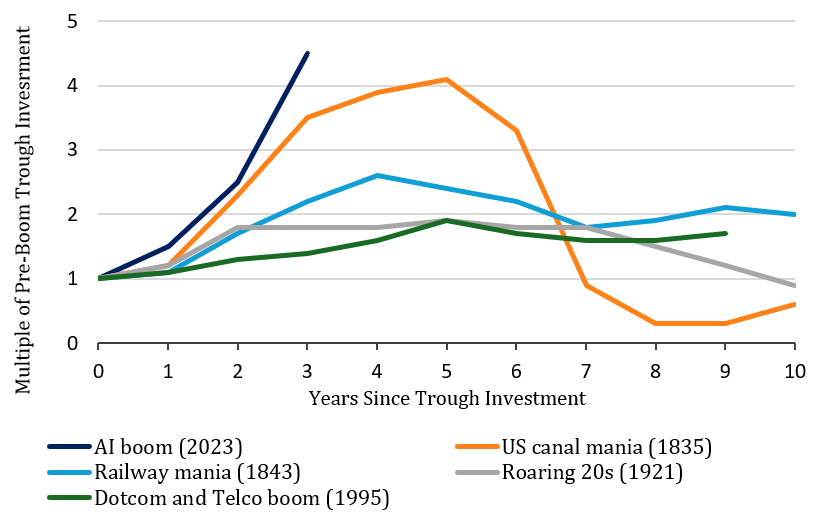
The same lesson runs throughout financial history. As shown in the graph above, canals once boomed, opening trade along America's rivers, but railroads undercut them within 20 years, leading to widespread defaults of canal operators. Railroads remade America, yet overbuilding, leverage and bankruptcy destroyed enormous amounts of investor capital; the Panic of 1893 alone pushed roughly a quarter of U.S. railroad trackage into receivership within a year, including the Northern Pacific, Union Pacific and Atchison, Topeka & Santa Fe. Electricity revolutionized industry, but many of the leveraged utility holding-company empires built around it collapsed in the early 1930s, prompting Congress to regulate the industry's financing directly.[16] The internet transformed commerce, yet shareholders and lenders suffered massive losses after investing at valuations the underlying businesses could never justify.[17]
The lesson from our last quarterly letter "Q1 2026 Commentary — Won't Get Fooled Again" still applies. A frontier can be real. The technology can work. The addressable market can appear almost limitless. Yet the future still must be financed, competition still matters, and capital still demands a return.
The table below provides more detail about several previous boom-bust cycles and their outcomes.
Capital Expenditures in Previous Boom-Bust Cycles vs AI Buildout[18]
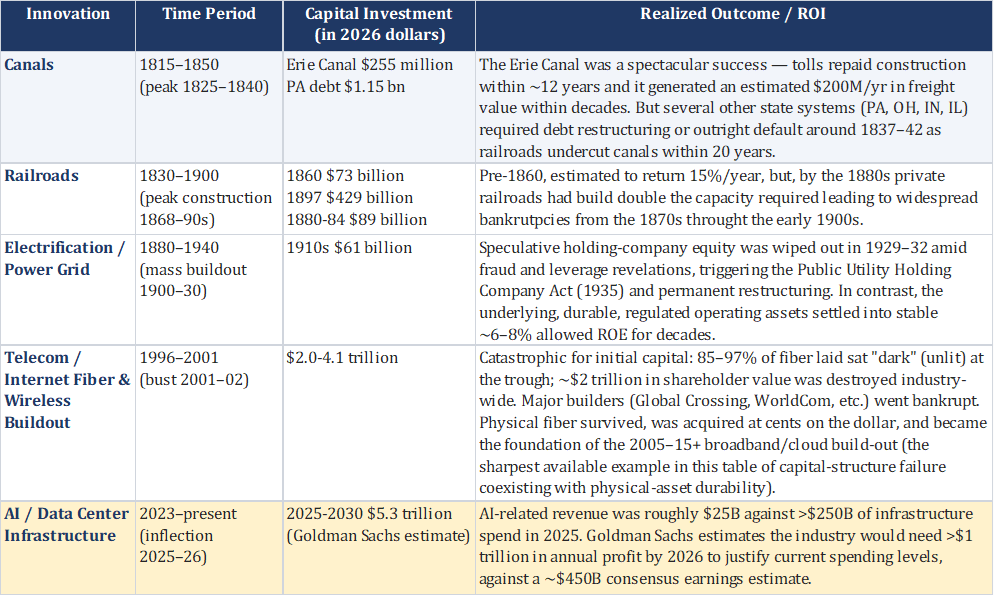
Most startling in the table above is the magnitude of the capital, $5.3 trillion through 2030,[19] projected to be necessary to fund the AI/Data Center buildout. Based on projected hyperscaler spending[20] and growth in Gross Domestic Product (GDP),[21] AI-related investment is projected to rise from 2.5% of GDP in 2026 to 4.3% in 2028, accounting for 52.1%, 79.7%, and 28.8% of GDP growth, respectively in 2026–2028. For comparison and perspective, capital spending in 2000, at the height of the telecom boom, accounted for 1.2% of GDP and only 5.8% of GDP growth.[22] Clearly, the U.S. economy is all-in on AI.
At CrossingBridge, we remain skeptical and cautious with respect to credit investments in the AI buildout. History suggests many concerns:
- Will AI users see enough return on investment to justify their purchase of the tokens required to use AI?
- What moat do developers of the most advanced "frontier models" of AI (e.g., Anthropic and OpenAI) have to protect themselves from competition from secondary or open-source models, many from China, which can provide results that are "nearly as good" at a fraction of the cost?
- Will the Jevons Paradox[23] kick in, causing a rise in expenditures for tokens, as a result of greater usage as the price of tokens declines?
- Will AI model companies generate enough cash flow to pay for the infrastructure being built out by the hyperscalers (e.g., Amazon, Meta, Google, Microsoft)?
- If Elon Musk is successful in developing orbital data centers, will they render obsolete the terrestrial infrastructure the way railroads superseded canals?
- Given the vast amount of capital required and creativity being applied to structured financings for AI infrastructure, are credit investors paying close enough attention to the lender protections in their terms?
Despite these concerns, we have analyzed several financings for AI infrastructure and invested in one that we thought afforded us an acceptable return with suitable terms. Notably, this credit comes from the Nordic credit market where we often find better value.
PolarDC Finance (POLADC) EURIBOR[24] + 600 basis points (bps) due 2030[25] - Polar DC entered the Nordic market with a 4-year senior secured bond offering to fund its 93MW data center buildout in Norway, with anchor tenants Crusoe and CoreWeave. Norway offers meaningful structural advantages as a data-center market: abundant renewable power[26], a cool climate that can improve cooling efficiency, and a national government broadly supportive of investment. These advantages may translate into lower operating costs and potentially fewer conflicts than in some U.S. markets, although electricity prices, grid availability, and local permitting conditions vary considerably by location. These factors improved the economic viability of the underlying asset and reduced the risk of tenant abandonment over the bond's life.
|
|
Applied Digital |
Polar DC |
|
Bond Issue (mil) |
$2,350.0 |
$750.0 |
|
DC Facility size |
250MW |
93MW |
|
Buildout Cost |
~$12mil/MW |
~EUR 10.1mil/MW |
|
Tenant (s) |
Core Weave |
Crusoe, Core Weave |
|
Lease Terms |
15 yrs +10 (ext'n) |
10 yrs + 3 (ext'n) for Crusoe |
|
Coupon |
9.25% |
~EUR +600 bps |
|
Current YTM |
6.80% |
~8.28% |
|
Maintenance Covenants |
None |
• Liquidity ≥ EUR 20m |
|
Permitted Distributions |
• Up to 30% of NOI once leases have commenced |
Up to EUR 1m max |
|
Bond Tenor |
5 years |
4 years |
|
Amort |
Semi Annual, ~25% by bond maturity |
None |
|
Permitted debt |
• Credit facilities up to 50% of NOI |
EUR 100mil tap + 35m general basket |
|
Stabilized Leverage |
7.0x |
8.8x |
|
NOI Margin |
88% |
78% |
We benchmarked this issue (see table above) against the Applied Digital (APLD) bonds due 2030 — U.S. senior secured bonds issued to fund the buildout of a data center in Ellendale, North Dakota, where CoreWeave is also a tenant. We concluded that the PolarDC was superior on both terms and yield. The security packages are comparable: both offer first lien pledges over shares in the issuer and Group companies directly holding the data center properties and include first lien mortgages over each data center, claims over rental income contracts, a pledge over bank accounts. Notably, Polar DC provides superior bondholder protection through stricter covenants such as minimum liquidity, maximum loan-to-value ("LTV") maintenance covenants, and minimal permitted distributions (maximum EUR 1 million). With similar tenor and counterparty risk, the Polar DC bond priced at EUR +600 bps as compared to the APLD bond trading at approximately 266 bps over the Treasury rate at the time — a spread pickup of roughly 334 bps for a deal we assessed as carrying equivalent or lower risk. We viewed this as a compelling relative value opportunity and participated in the new issue.
CrossingBridge Advisors Portfolio Statistics — June 30, 2026
| CBUDX | CBLDX/ CBLVX |
CBRDX | RSIIX/ RSIVX |
NRDCX* | |
|---|---|---|---|---|---|
| Yield to Worst (YTW) | 5.20% | 6.61% | 7.73% | 8.02% | +396 |
| YTW Duration | 0.52 | 0.84 | 0.79 | 1.65 | 0.82 |
| Yield to Maturity (YTM) | 5.30% | 6.78% | 7.91% | 8.16% | +401 |
| YTM Duration | 0.99 | 1.61 | 1.89 | 2.37 | 2.38 |
| Yield Extension | 0.09% | 0.17% | 0.18% | 0.14% | +5 |
| Duration Extension | 0.48 | 0.77 | 1.10 | 0.72 | 1.56 |
| Investment Grade | 72.59% | 36.35% | 24.23% | 18.42% | 17.56% |
| High Yield | 15.47% | 48.47% | 58.50% | 64.79% | 69.94% |
| Cash & Other | 11.94% | 15.18% | 17.26% | 16.80% | 12.50% |
| Floating Rate | 14.3% | 24.4% | 36.7% | 21.5% | 62.8% |
| Leveraged Loans | 9.1% | 15.3% | 8.7% | 20.9% | 1.9% |
| Foreign Exposure | 17.3% | 19.1% | 32.4% | 20.6% | 86.5% |
| Dry Powder | 42.1% | 30.8% | 28.5% | 24.7% | 12.5% |
| *NRDCX YTW/YTM: Spreads to Worst and Spreads to Maturity over benchmark rates listed, which is deemed a more appropriate measure with >80% of the portfolio invested in foreign domiciled bonds as well as multiple currencies (EUR 43.1%, NOK 28.9%, SEK 15.7%, USD 12.3% of invested portfolio). | |||||
In the markets, not much has changed since we published our 1Q26 investor commentary. Credit spreads remain tight and valuations appear overextended. Uncertainty surrounding the war in Iran persists with an "on-again, off-again" peace process adding to market volatility.
As expected, Kevin Warsh took over as Chairman of the Federal Reserve. During the confirmation process, he echoed President Trump's view that the Fed should lower interest rates, but, following his first FOMC meeting on June 17, Warsh sounded more hawkish on inflation than many investors had anticipated. As of June 30, Fed Funds Futures[27] are implying at least one increase in rates by year end.
Against this backdrop, we have remained cautious. Over the past twelve months, we generally increased the allocation to investment grade credit, reduced exposure to high yield and added to "dry powder."[28] We continue to pick our spots carefully, committing capital only where we believe spreads and structure offer sufficient compensation for the risks assumed, while preserving liquidity for more attractive opportunities.
The relatively modest yield pickup currently available for moving down in credit quality has made much of the high-yield market less compelling. We have therefore favored investment-grade credit while remaining open to select high-yield opportunities. Below, we discuss three investment-grade credits purchased during 2Q26 and one high-yield investment. We believe two of these ideas demonstrate why prior credit work can be "the gift that keeps giving": Warner Media presented a renewed investment opportunity, while our experience and relationships gained through our investment in Bally's helped us identify another high-yield opportunity.[29]
Credit Spread (bps) Per Turn of Leverage Across Comparable Maturities[30]
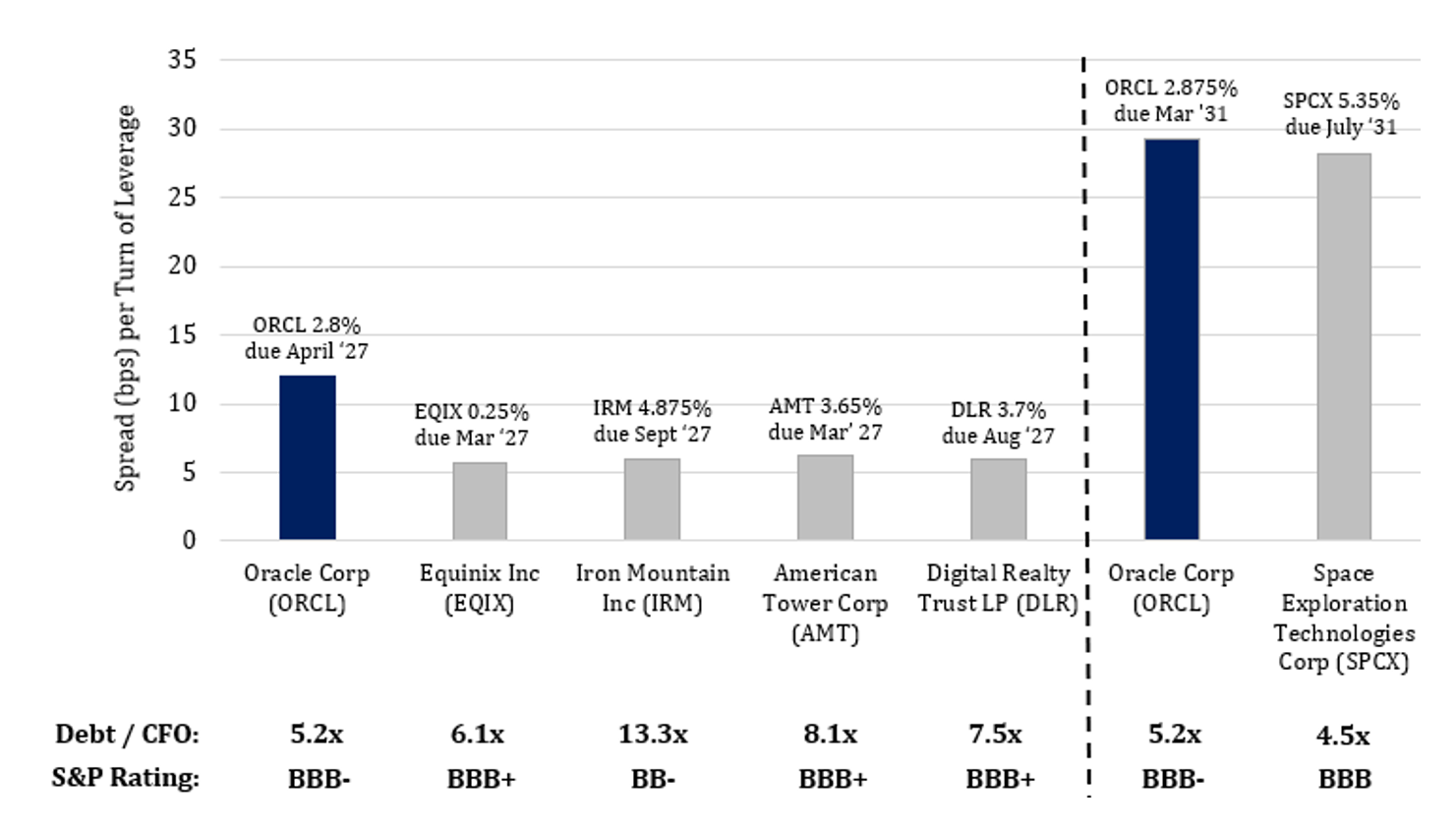
Oracle Corporation (ORCL) 2.80% Senior Unsecured Bonds due 2027 and 3.25% Senior Unsecured Bonds due 2027[31] - ORCL remains a high-quality, investment-grade software and cloud infrastructure provider, characterized by highly recurring revenue and strong free cash flow generation. During the quarter, we took advantage of a pricing dislocation in the company's short-dated bonds, opportunistically buying two of ORCL's short-dated bonds, rated BBB-/Baa2, due 2027, at elevated spreads of +94 to +102 bps — a highly attractive entry point compared to the roughly +49 bps observed at the end of 2025. As shown in the graph above, the credit spread for ORCL’s short-term bond, on a spread per turn of leverage basis, is about double that of bonds of similar maturities issued by other investment grade credits in adjacent industries due to market concerns regarding the scale of ORCL’s AI-driven investment cycle, its associated funding needs, and broader questions surrounding sector-wide AI capital expenditures.
In our view, the market is significantly overstating the risk, underappreciating the resilience of the company's underlying business and its robust access to capital markets. In February, the company directly addressed these concerns by executing a comprehensive financing plan. This included a $25 billion senior unsecured bond issuance, approximately $5 billion in mandatory convertible preferred equity, and the authorization of a $20 billion at-the-market (ATM) equity program. These actions strongly reinforced ORCL's commitment to maintaining its investment-grade balance sheet. We remain confident that the company is exceptionally well-capitalized to easily address its near-term liabilities.
It is worth noting that ORCL’s 5-year bonds, as shown in the graph above, also provide a slightly higher yield, on a spread-per-turn basis, than SpaceX’s recently issued 5-year bonds. We find the comparison instructive. Both companies are using cash generated by highly profitable, established businesses — Oracle's software and cloud data services, and SpaceX's Starlink network — to finance ambitious, capital-intensive buildouts of their AI ventures. Elon has the "Musk-touch," an ability to envision a future no one believes possible and make it possible. But Larry Ellison is certainly no slouch. He is a legendary entrepreneur who has navigated multiple technology and market cycles. Though separated by nearly three decades and shaped by different business backgrounds — Ellison in enterprise software and databases, Musk in internet payments, automobiles, rockets, and other capital-intensive industries — they are approaching the AI boom with a similar strategy: using the cash flows of established businesses to finance the infrastructure of tomorrow.
As a "sidebar", the Ellison family trust, holding approximately 1.16 billion Oracle shares, has guaranteed $40.4 billion of Paramount Skydance's bid for Warner Bros. Discovery — the credit we discuss next.
Warner Bros Discovery (WBD) SOFR[32] + 250 bps First Lien Term Loan due 2033[33] - Warner Bros. Discovery is a global media company whose assets include the Warner Bros. film and television studio, HBO Max, and a portfolio of cable networks. Following its previously announced merger with Paramount, the company sought to refinance the $15 billion bridge facility put in place to support prior strategic initiatives. With the legacy bridge becoming increasingly expensive and the merger timeline extending, WBD came to market with a new $13 billion first lien secured term loan, rated BBB-/Baa3, at attractive pricing. We participated in the financing, viewing the risk/reward as favorable regardless of the merger outcome. If the transaction closes, the term loan is subject to a change of control provision requiring repayment at par, allowing us to realize an attractive spread over Treasuries on paper purchased at a discount. If the merger is terminated, we believe the downside would be well protected. WBD would receive a $7 billion breakup fee, materially reducing leverage, while the loan benefits from first lien claims and guarantees from the company's highest-quality assets, including its studio and streaming businesses, which generate sufficient free cash flow to support the credit and have attracted meaningful strategic interest. Following the initial issuance, we added to our position at prices modestly above par as we continued to view either outcome attractive. Our blended purchases were made at a spread of 250 bps over SOFR for a 6.1% yield to maturity, and a 5.4% yield assuming repayment on September 30, 2026, after which date Paramount begins paying a "ticking fee" to WBD shareholders.
Spirit Airlines (SAVE) 4.100% Pass Through Trust 2015-1A[34] - Spirit Airlines emerged from Chapter 11 in March 2025 with reduced debt and new equity. We passed on its mid-teens yielding 11% senior secured notes due 2030 given our view that the reorganized balance sheet remained overleveraged and positive free cash flow generation depended on resolving costly aircraft leases and favorable fuel prices, factors out of the Company's control. Instead, we purchased Spirit's investment-grade rated 2015-1A 4.100% Enhanced Equipment Trust Certificates, or EETCs, due April 2028. The certificates are secured by 15 Airbus A320 and A321 aircraft, which we estimated provided approximately 2.0x collateral coverage. Importantly, EETCs benefit from Section 1110 of the Bankruptcy Code, which generally requires an airline to cure defaults within 60 days of a bankruptcy filing or surrender the aircraft to creditors, bypassing the traditional automatic stay by prompting immediate repayment. We began purchasing the certificates in August 2025 at 92.50, or a 7.3% YTM, an attractive return for a short-duration, overcollateralized security with a free option on a future liquidation should the company's turnaround fail.
Days after our initial purchase, Spirit returned to Chapter 11. In the ensuing months, fuel price volatility following the outbreak of hostilities in Iran derailed its restructuring. In early May 2026, the company announced it would liquidate. After Spirit missed a principal payment, we added to our position at approximately 96.50, a 6.1% YTM. CrossingBridge joined an ad hoc group of equipment trust holders and entered into a cooperation agreement under which junior EETC holders would credit bid their claims and repay the senior tranches, including the 2015-1As, at par plus accrued interest. Spirit subsequently filed a sale motion to implement this transaction with the bankruptcy court which we expect will receive approval. Should the sale proceed as contemplated, we expect repayment no later than September 30, 2026, resulting in an annualized return of approximately 13%.
888 Acquisitions Ltd. (GAMHOL) SOFR + 525 bps Secured Term Loan due 2028[35] - 888 Acquisitions is the debt-issuing subsidiary of publicly traded Evoke plc (EVOK LN), a U.K.-based operator of online and retail gaming brands including William Hill, 888casino, and Mr. Green. Following the debt-financed acquisition of William Hill in 2022, leverage remained elevated, but the turnaround began to take hold in 2024 and leverage fell below 5.0x by 2025, with a credible path towards 3.5x. That progress was interrupted in late 2025 when the U.K. government announced a larger-than-expected increase in remote gaming duties. GAMHOL's debt sold off sharply after Evoke withdrew its medium-term guidance and retained financial advisors to evaluate strategic alternatives.
The setup was familiar, as our position in Bally's term loan, discussed in prior investor letters, had recently been repaid. Like Bally's, Evoke is comprised of several distinct businesses requiring separate valuation: mature, cash-generative William Hill retail shops, a modestly growing U.K. and Ireland online sports betting business, and a higher-quality, international online business with operations in Italy, Spain, Romania, and Denmark. We concluded that the value of these assets covered the debt with a margin of safety, even if they ultimately had to be monetized separately. Liquidity and underlying cash generation also provided a cushion against the tax increase isolated to the U.K. online business. We purchased the senior secured term loan due 2028, floating-rate senior secured notes due 2028, and 10.75% senior secured notes due 2030 in the low 90s at YTMs of approximately 10%–13%.
Reports that Bally's-controlled Intralot was considering an acquisition provided an additional catalyst. Based on our prior experience with Bally's, we believed a combination would be strategically compelling, accretive, and financeable. In early June, Evoke announced an agreement to be acquired by Bally's Intralot. Under the complex transaction, GAMHOL would remain a separate credit silo, with a backstopped second-lien facility expected to refinance the 2028 maturity with all other debt remaining outstanding. Despite the increase in GAMHOL's credit quality, we sold the floating-rate notes and 2030 notes above par as our catalyst had occurred, and redeployed capital into the 2028 term loan at par. With financing committed and closing expected by the end of 1Q27, we expect to earn SOFR+525 bps while awaiting repayment at par.
Dreams may reach the stars. Returns remain grounded in economics.

David Sherman and the CrossingBridge Team
The Funds' Subsidized/Unsubsidized SEC yields as of 6/30/26 were as follows:
CrossingBridge Low Duration High Income Fund (CBLDX): 5.73%/5.73%
CrossingBridge Low Duration High Income Fund (CBLVX): 5.47%/5.47%
CrossingBridge Ultra-Short Duration Fund (CBUDX): 3.74%/3.68%
CrossingBridge Responsible Credit Fund (CBRDX): 6.35%/5.90%
Nordic High Income Bond Fund (NRDCX): 7.39%/7.34%
RiverPark Strategic Income Fund (RSIIX): 8.14%/8.14%
RiverPark Strategic Income Fund (RSIVX): 7.88%/7.88%
Disclosures
Must be preceded or accompanied by a prospectus. The prospectus for the CrossingBridge Ultra-Short Duration Fund, CrossingBridge Low Duration High Income Fund, CrossingBridge Responsible Credit Fund, CrossingBridge Nordic High Income Bond Fund, and RiverPark Strategic Income Fund can be found by clicking here. To obtain a hardcopy of the prospectus, call 855-552-5863. Please read and consider the prospectus carefully before investing. Per rule 30e-3, the fiscal Q1 holdings and Q3 holdings can be found by clicking on the respective links.
Any performance data quoted represents past performance. Past performance does not guarantee future results. The investment return and principal value of an investment will fluctuate so that an investor's shares, when redeemed, may be worth more or less than their original cost. Current performance may be lower or higher than the performance quoted. Performance data current to the most recent month end may be obtained by calling 914-741-1515. Please Find the Most Current standardized performance For Each Fund as of the most recent quarter-end By clicking the following links: CrossingBridge Low Duration High Yield Fund, CrossingBridge Ultra-Short Duration Fund, RiverPark Strategic Income Fund, CrossingBridge Nordic High Income Bond Fund, and CrossingBridge Responsible Credit Fund.
The funds are offered only to United States residents, and information on this site is intended only for such persons. Nothing on this website should be considered a solicitation to buy or an offer to sell shares of the fund in any jurisdiction where the offer or solicitation would be unlawful under the securities laws of such jurisdiction.
CrossingBridge Funds' disclosure: Mutual fund & ETF investing involves risk. Principal loss is possible. Investments in foreign securities involve greater volatility and political, economic and currency risks and differences in accounting methods. Investments in debt securities typically decrease in value when interest rates rise. This risk is usually greater for longer-term debt securities. Investment in lower-rated and non-rated securities presents a greater risk of loss of principal and interest than higher-rated securities. Because the fund may invest in ETFs and ETNs, they are subject to additional risks that do not apply to conventional mutual fund, including the risks that the market price of an ETF's and ETN's shares may trade at a discount to its Net Asset Value ("NAV"), an active secondary trading market may not develop or be maintained, or trading may be halted by the exchange in which they trade, which may impact a fund's ability to sell its shares. The value of ETNs may be influenced by the level of supply and demand for the ETN, volatility and lack of liquidity. The fund may invest in derivative securities, which derive their performance from the performance of an underlying asset, index, interest rate or currency exchange rate. Derivatives can be volatile and involve various types and degrees of risks, and, depending upon the characteristics of a particular derivative, suddenly can become illiquid. Investments in asset-backed, mortgage-backed, and collateralized mortgage-backed securities include additional risks that investors should be aware of, such as credit risk, prepayment risk, possible illiquidity and default, as well as increased susceptibility to adverse economic developments. Investing in commodities may subject the fund to greater risks and volatility as commodity prices may be influenced by a variety of factors including unfavorable weather, environmental factors, and changes in government regulations. Shares of closed-end funds frequently trade at a price per share that is less than the NAV per share. There can be no assurance that the market discount on shares of any closed-end fund purchased by the fund will ever decrease or that when the fund seeks to sell shares of a closed-end fund, it can receive the NAV of those shares. There are greater risks involved in investing in securities with limited market liquidity.
Definitions: The S&P 500, or simply the S&P, is a stock market index that measures the stock performance of 500 large companies listed on stock exchanges in the United States. The ICE BOFA Investment Grade Index tracks the performance of U.S. dollar-denominated investment grade-rated corporate debt publicly issued in the U.S. domestic market. The ICE BOFA High Yield Index tracks the performance of U.S.dollar-denominated, below investment grade rated corporate debt publicly issued in the U.S. domestic market. EBITDA is a company's earnings before interest, taxes, depreciation, and amortization is an accounting measure calculated using a company's earnings, before interest expenses, taxes, depreciation, and amortization are subtracted, as a proxy for a company's current operating profitability. A Basis Point (BP) is 1/100 of one percent. Pari-Passu is a Latin term that means 'on equal footing' or 'ranking equally'. It is an important clause for creditors of a company in financial difficulty which might become insolvent. If the company's debts are Pari-Passu, they are all ranked equally, so the company pays each creditor the same amount in insolvency. LIBOR is the average interbank interest rate at which a selection of banks on the London money market are prepared to lend to one another. Yield to Maturity (YTM) is the total return anticipated on a bond (on an annualized basis) if the bond is held until it matures. Free Cash Flow (FCF) is the cash a company produces through its operations, less the cost of expenditures on assets. In other words, Free Cash Flow is the cash left over after a company pays for its operating expenses and capital expenditures. Duration is a measure of the sensitivity of the price of a bond or other debt instrument to a change in interest rates. Debtor-in-Possession (DIP) financing is a special kind of financing meant for companies that are in bankruptcy. Only companies that have filed for bankruptcy protection under Chapter 11 are allowed to access dip financing, which usually happens at the start of a filing. Dip financing is used to facilitate the reorganization of a Debtor-in-Possession (the status of a company that has filed for bankruptcy) by allowing it to raise capital to fund its operations as its bankruptcy case runs its course. Yield to Call (YTC) refers to the return a bondholder receives if the bond is held until the call date, which occurs sometime before it reaches maturity. The SEC Yield is a standard yield calculation developed by the U.S. Securities and Exchange Commission (SEC) that allows for fairer comparisons of bond funds. It is based on the most recent 30-day period covered by the fund's filings with the SEC. The yield figure reflects the dividends and interest earned during the period after the deduction of the fund's expenses. It is also referred to as the "standardized yield." Yield to Worst is the yield on the portfolio if all bonds are held to the worst date; Yield to Worst date is the date of lowest possible yield outcome for each security without a default. Business Development Companies (BDCs) are investment vehicles that provide funding to small, medium-sized, and financially distressed companies, aiming to help them grow and regain financial stability.
All performance data greater than 1 year is annualized.
Diversification does not assure a profit nor protect against loss in a declining market.
A stock is a type of security that signifies ownership in a corporation and represents a claim on part of the corporation's assets and earnings. A bond is a debt investment in which an investor loans money to an entity that borrows the fund for a defined period of time at a fixed interest rate. A stock may trade with more or less liquidity than a bond depending on the number of shares and bonds outstanding, the size of the company, and the demand for the securities. The Securities and Exchange Commission (SEC) does not approve, endorse, or indemnify any security. Duration is a measure of the sensitivity of the price of a bond or other debt instrument to a change in interest rates.
Tax features may vary based on personal circumstances. Consult a tax professional for additional information.
The CrossingBridge Ultra-Short Duration Fund, CrossingBridge Low Duration High Income Fund, CrossingBridge Responsible Credit Fund, CrossingBridge Nordic High Income Bond Fund, and RiverPark Strategic Income Fund are distributed by Quasar Distributors, LLC.