
 On September 29th, 2025, a group of investors (Public Investment Fund of Saudi Arabia, Silver Lake, and Affinity Partners) announced a leveraged buyout of Electronic Arts ("EA")
EA Bonds - It's in the Docs
The Opportunity
On September 29th, 2025, a group of investors (Public Investment Fund of Saudi Arabia, Silver Lake, and Affinity Partners) announced a leveraged buyout of Electronic Arts ("EA"), a publicly owned developer, publisher, and distributor of branded video game software.
At that time, EA had three BBB+ -rated bonds outstanding:
- 4.80% Senior Notes due 3/1/26
- 1.85% Senior Notes due 2/15/31
- 2.95% Senior Notes due 2/15/51
Investors saw the $55 billion take-private deal, and many believed they had found an easy opportunity to make some money. The outstanding bonds included a Change of Control provision, which allows bondholders to "put" the bonds to the company at 101 if the deal closes. So, the trade seemed simple: buy the bonds, wait for the deal to close, collect 101, and make a nice return. As shown in the graph below, the 2031 and 2051 bonds experienced a sharp price increase following the deal's announcement.
Electronic Arts Bonds Prices1
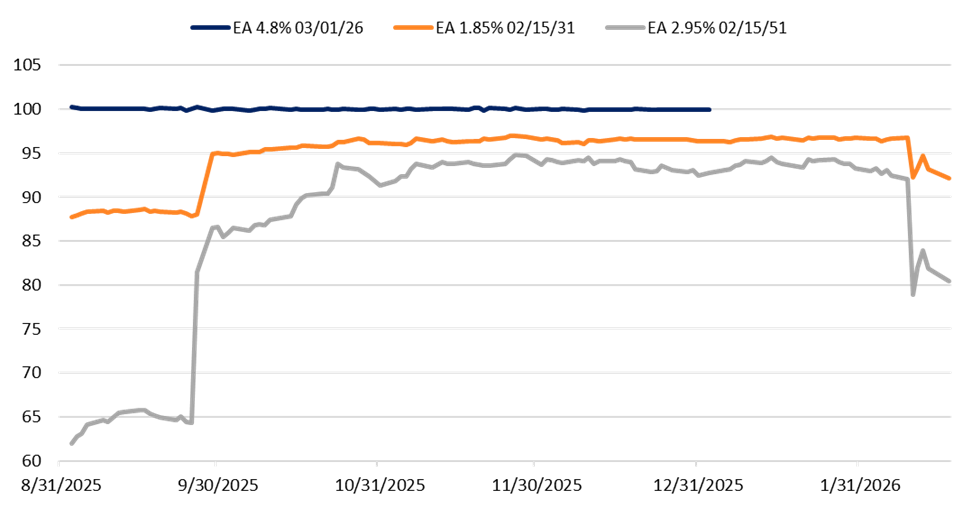
That said, the subsequent price drop in February 2026 reflects one of the cardinal rules of credit investing: read the docs. The range of outcomes looks quite different when you read the (not so) fine print…
Outcome 1: The Deal Falls Apart
If the transaction fails, the acquisition premium that was embedded in the 2031 and 2051 bonds after they spiked upward on the deal announcement is likely to disappear with prices drifting back toward pre-announcement levels. At that point, investors would simply be holding low coupon, long-dated bonds, trading at a discount, with significant duration risk.
Outcome 2: The Deal Moves Towards Closing
This is where things get more complicated and attention to the terms of the bonds is critical. Even if the deal proceeds as planned, the issuer has several tools at its disposal to ensure that they never have to repay the bonds at 101.
Tool 1: Tender Offer - The acquiring sponsors can launch a tender offer, typically at a discount to par.
Outcome for bondholders:
- Positive: They exit a bond with a low coupon and, likely, lower credit quality due to the addition of debt required to finance the deal.
- Negative: They receive less than a par recovery for the bond.
Outcome for issuer/private equity sponsor:
- Positive: They capture a portion of the discount as a result of the tender, reducing the purchase price of the transaction to the detriment of bondholders.
Tool 2: Consent Fee – The acquiring sponsors can offer to pay a fee to bondholders in exchange for a waiver of the Change of Control provision.2
Outcome for bondholders:
- Positive (slight): They receive a fee of a few points in consideration for waiving their right to put the bond at 101.
- Negative: They continue to hold a low-coupon, long-dated bond that is likely to be riskier due to the addition of new debt pari-passu or senior to the existing bonds.
Outcome for issuer/private equity sponsor:
- Positive: They get to keep attractive long-term, low-cost financing in the capital structure at a low incremental cost.
Tool 3: Defeasance – If provided in the bond indentures and both the Tender and Consent Fee options fail, the company still has another option: defeasance. In a defeasance transaction, the issuer deposits Treasury securities into an escrow account to cover the remaining interest and principal payments of the bonds, effectively removing them from the capital structure.
Outcome for bondholders:
- Positive: Credit risk is effectively eliminated as payment of all principal and interest is secured by escrowed Treasury Bonds.
- Negative: The low-coupon, long-dated bonds will remain outstanding until maturity. The bonds are likely to trade at yields in line with U.S. Treasury Bonds of similar maturity.
Outcome for issuer/private equity sponsor:
- Positive: Rather than raising the funds necessary to repay the bonds at 101, the private equity sponsor will only raise enough capital necessary to purchase the U.S. Treasury bonds required to defease the bonds.
This is where incentives come into play
In general, debt issuers want to reduce financing costs, not maximize bondholder returns. This means they will typically pursue whichever option is most economically advantageous to them. As Charlie Munger famously said: "Show me the incentive and I'll show you the outcome."
In this case, the incentives were clear:
- Issuer objective: minimize financing costs
- Bondholder objective: maximize repayment value
Those interests were never aligned. And, given the tools that EA had at their disposal per the bond indenture, a quick read would quickly reveal that EA and its private equity acquirors had the upper hand.
Our Play
- Purchased: 4.80% Senior Notes due 3/1/26
- Avoided: 1.85% Senior Notes due 2/15/31
- Avoided: 2.95% Senior Notes due 2/15/51
Reviewing the potential outcomes, we recognized that downside risk was substantial for the longer dated paper – nearly 10 points for the 31s and 30 points for the 51s - if the deal did not close. Moreover, although the bonds were likely "money good,"3 if the deal fell through and we were stuck with the bonds, they would be a bad fit for us in the context of our short-term strategies. Their long maturity and low coupon made early repayment unlikely.
Instead, we purchased the 2026 bond on 10/3/25 at 100.10, comfortable that the bond would be repaid no later than the 3/1/26 maturity, regardless of whether the go-private transaction was completed. This would result in a yield ranging from 4.12%, if it were redeemed at the first call date, to 4.53%, if it remained outstanding until 3/1/26 maturity. Depending on the repayment date, this was about 30-71 basis points4 better than the yield of the 6-month Treasury, which we saw as very compelling for such a low-risk instrument.
The Outcome
Indeed, on February 10, 2026, the company announced a discounted tender for the longer-dated bonds, offering to repurchase the 2031 bonds at about 91 and the 2051 bonds at about 73 cents5 subject to closing of the acquisition of the company. The tender offer also included a coercive "exit consent" that, subject to more than 50% of the bonds being tendered, stripped any untendered bonds of certain terms, including the change-of-control provision, to the bondholders' detriment.
The company further increased pressure on bondholders to accept the tender offer by threatening to "defease" any bonds that were not tendered, as permitted in the bond indenture. Because the proposed tender prices implied yields similar to Treasuries with comparable maturities, any defeased bonds would likely trade at prices around those offered in the tender. Thus, the bondholders faced a "lose-lose" situation: the result was nearly the same whether they tendered their bonds or held onto them.
As shown in the graph above, prices for the 2031 and 2051 bonds declined after the tender offer was announced. Unsurprisingly, the bondholders are gathering their army of lawyers and preparing to engage in a legal battle to fight this brazen tactic. We'd rather watch this fight from the sidelines.
Final Thoughts
In credit investing, the outcome is frequently written long before the event. The outcome of this situation was never determined by the press release announcing a $55 billion buyout. It was determined years earlier, in 2016, when the bond indenture was written, and the issuer preserved multiple paths to avoid paying bondholders 101 upon a change of control. In the end, the best decision was to not play the game.
Back to the docs,
Michael De Kler and the CrossingBridge Team
Disclosures
This document shall not constitute an offer to sell interests in any funds managed by CrossingBridge Advisors, LLC and/or affiliates described herein or a solicitation of an offer to purchase such interests. Any such offer will only be made pursuant to a prospectus for each fund, which contains more detailed information about the fees, expenses, terms and risks of investing in each fund. The terms described herein are subject to change.
Nothing contained herein constitutes investment, legal, tax or other advice, nor is it to be relied on in making an investment or other decision.
Material in this publication is for general information only and is not intended to provide specific investment advice or recommendations for any purchase or sale of any specific security or commodity.
The information in this presentation has been obtained or derived from sources believed to be reliable by CrossingBridge but CrossingBridge does not represent that the information provided is accurate or complete. Any opinion or estimates or calculations in this presentation represent the judgment of CrossingBridge at the time and subject to change without notice.
Nothing in this document constitutes a representation that any investment strategy or recommendation is suitable or appropriate to an investor's individual circumstances or otherwise constitutes a recommendation.
CrossingBridge Advisors LLC is a Securities and Exchange Commission (SEC) registered investment adviser, with the Firm's headquarters in Pleasantville, NY, USA. Being registered does not imply a certain level of skill or training. The information in this document has not been approved or verified by the SEC. Additional information about CrossingBridge Advisors, LLC is available on the United States Securities and Exchange Commission's website at https://adviserinfo.sec.gov/firm/summary/286594.
Investing involves risk and principal loss is possible.
Definitions: A Basis Point (BP) is 1/100 of one percent. Duration is a measure of the sensitivity of the price of a bond or other debt instrument to a change in interest rates.
A stock is a type of security that signifies ownership in a corporation and represents a claim on part of the corporation's assets and earnings. A bond is a debt investment in which an investor loans money to an entity that borrows the fund for a defined period of time at a fixed interest rate. A stock may trade with more or less liquidity than a bond depending on the number of shares and bonds outstanding, the size of the company, and the demand for the securities.